Home › AC Repair
AC Repair in Columbia, TN
For AC repair in Columbia, TN, the call usually starts the same way: the AC is running but not cooling. The cause is usually one of six things: a clogged filter, a frozen coil, low refrigerant from a leak, a failed capacitor, dirty outdoor coils, or duct leaks. We test for each one at your house, show you what we found, and put the repair price in writing before we start.
5-star ratedLicensed & insured in Tennessee25 years in businessColumbia, TN · Price in writing before work starts
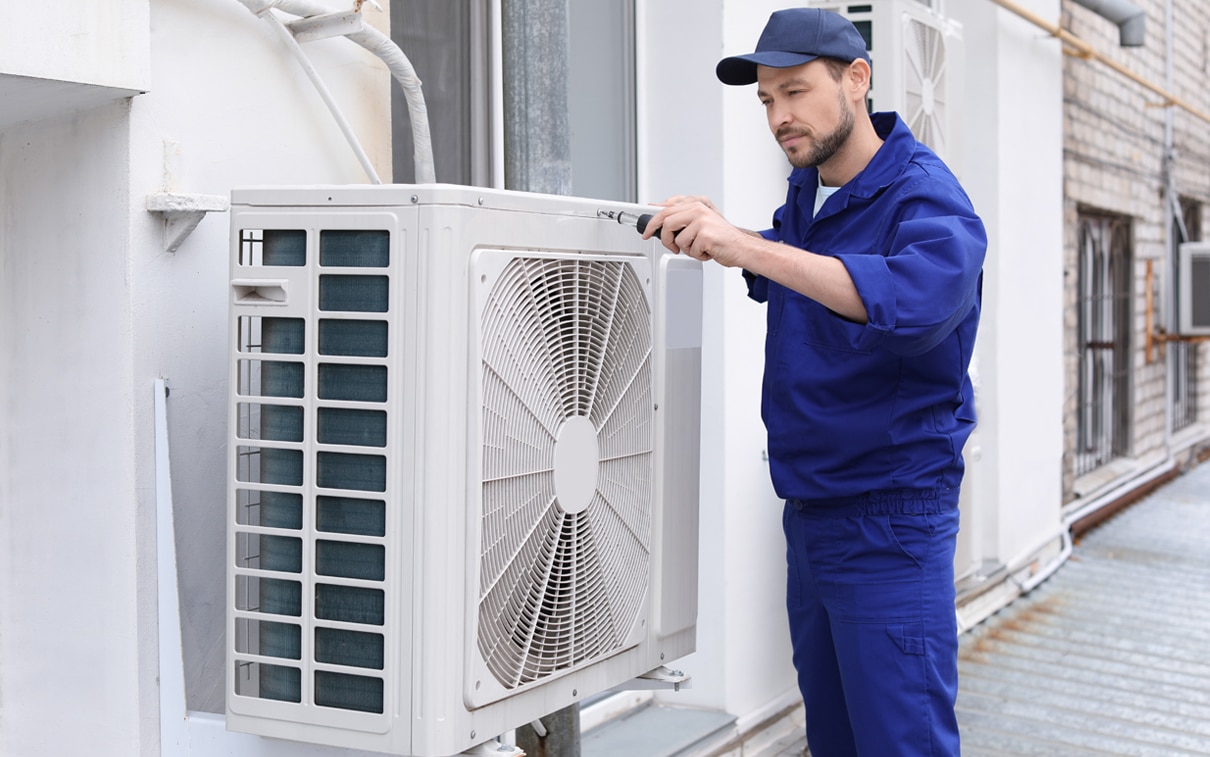
Symptoms we get called for, and what they usually mean
| What you notice | Likely causes | What to do first |
|---|---|---|
| AC runs, air is warm or barely cool | Low refrigerant, dirty coils, weak compressor, thermostat set to fan-only | Check filter and that the thermostat says Cool, not Fan. Then call. |
| Ice on the lines or the indoor coil | Low airflow from a clogged filter, or low refrigerant | Cooling off, fan On, let it thaw fully. Do not chip the ice. |
| Water around the air handler or through a ceiling | Clogged condensate drain — very common in Columbia humidity | Turn the system off to stop more water, then call the same day. |
| Outdoor unit hums but the fan will not start | Failed capacitor or contactor | Turn it off so the motor is not damaged. This is often a same-visit fix. |
| System will not turn on at all | Tripped breaker, float switch on a full drain pan, thermostat fault, control board | Check the breaker once. If it trips again, stop and call. |
| Short cycles — on and off every few minutes | Oversized system, low refrigerant, dirty coil, failing controls | Note how long each run lasts. That detail helps the tech. |
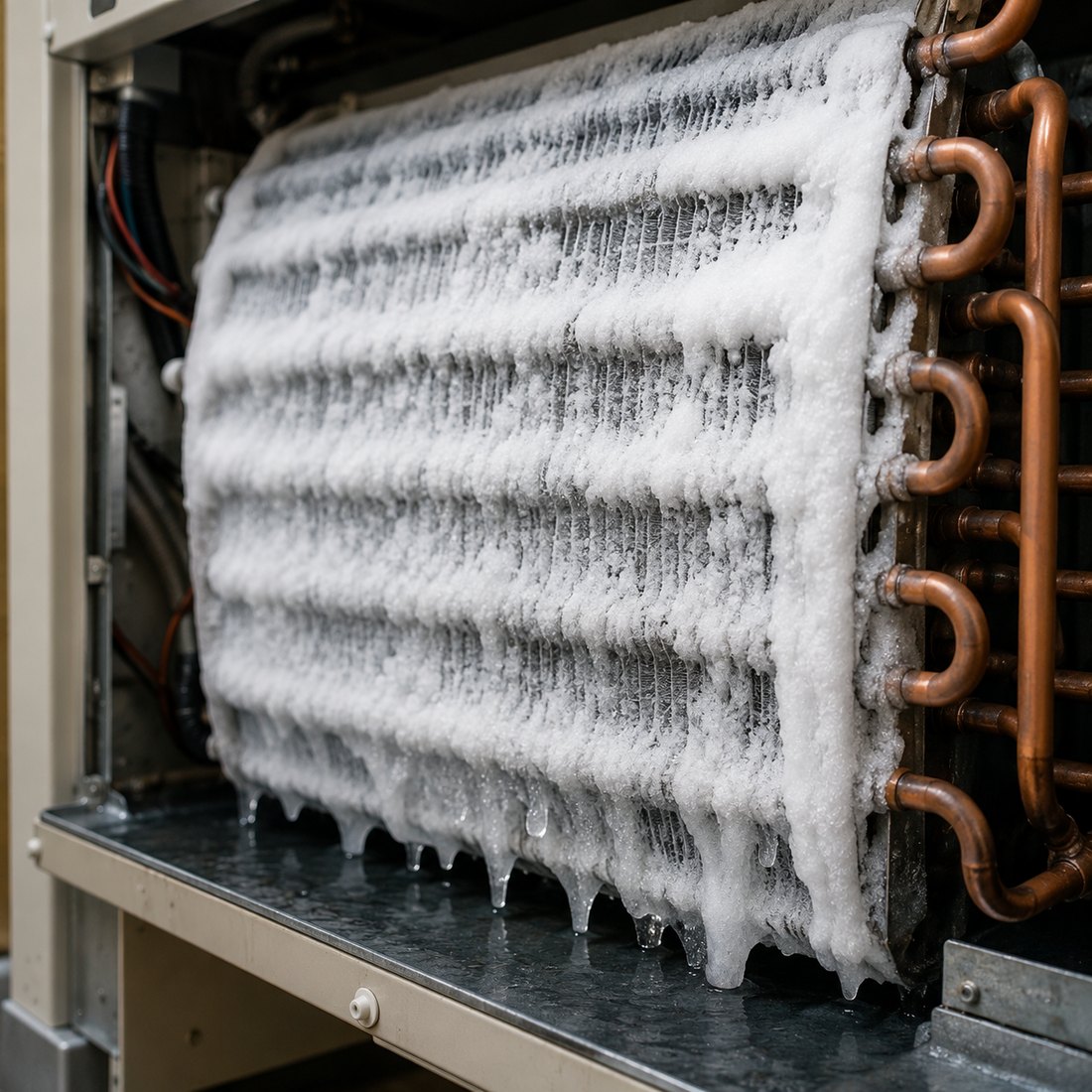
Frozen AC? Do these six things, in this order
Cooling off
Set the thermostat so cooling stops. Do not keep running a frozen system hoping it pushes through.
Fan to On
Warm house air across the coil melts the ice. A full thaw can take a few hours. Patience here is free; a compressor is not.
Towel by the indoor unit
All that ice becomes water. If the drain is slow or clogged, the pan can overflow while it melts.
Pull the filter
Clogged solid? You may have found your cause. Change it and note the date — filters are the cheapest part on the whole system.
Hands off the ice
Never chip or pry. Coils bend and puncture with very little force, and a puncture turns a thaw into a coil job.
It freezes again? Call
A second freeze after a full thaw and a clean filter points to low refrigerant from a leak, or an airflow fault. Both need gauges, not guesswork.
Water where it should not be — the condensate cluster, in one place
In a Columbia summer, water calls are their own group, and they share one system: the condensate drain. Cooling pulls moisture out of the air all day, and that water has to leave through a drain line and pan. When it cannot, it shows up five ways:
| What you see | What it usually means | What to do |
|---|---|---|
| Water pooling around the indoor unit or in the utility room | Drain line clogged with algae or debris, or a pan that is not draining | Turn cooling off to stop making more water, then call the same day |
| AC overflowing, or water leaking onto the floor below | Pan full and spilling over, or a cracked or rusted pan | System off. Water spreads into floors and ceilings faster than most breakdowns do damage |
| Dripping from an access panel or the front of the air handler | Excess condensation backing up inside the unit, often a slow drain plus a dirty coil | Note where the drip starts and call — the start point tells the tech which part of the drain path failed |
| System shut itself off and the drain pan is full | The float switch did its job and stopped the unit before the pan overflowed | That is protection, not a second fault. The drain needs clearing, not just a restart |
| Ceiling stain under an attic unit | Attic pan or drain backing up above the ceiling | System off and call the same day — attic water damage grows by the hour |
The fix order is the same on every one of these: clear the drain, test the float switch, check the pan, and confirm the line drains freely before the system goes back on. That drain check is part of every cooling repair we close out, and it is also on the spring tune-up checklist, because a drain cleared in April does not flood a ceiling in July.
The parts customers name on the phone — what each one does
A lot of callers already have a part name from a neighbour, a video, or a previous tech. Naming the part is a good start — here is what each part actually does, and how we confirm it before anyone pays for it:
| Part | Job it does | How failure shows up |
|---|---|---|
| Capacitor | Helps the outdoor fan and compressor start and keep running | Unit hums but the fan will not start, hard starts, or no start at all. Tested against its rating — measured vs rated goes on your invoice |
| Contactor | The switch that sends power to the outdoor unit when the thermostat calls | Buzzing at the outdoor unit, unit will not start, or a unit that will not shut off |
| Compressor | Pumps refrigerant around the sealed loop — the heart of the system | Breaker trips on start, loud hard starting, or a unit that runs with no cooling. This is a major part, so the repair price and the replacement price go side by side |
| TXV (thermal expansion valve) | Meters refrigerant into the indoor coil at the rate the coil can use | Cooling that fades, a coil that freezes despite clean airflow, or charge readings that do not behave. Confirmed by pressure and temperature readings, not by guessing |
| Control board | Directs the sequence — what starts, in what order, and what shuts down on a fault | Nothing responds, intermittent stops, or power present everywhere except where the board should pass it on. Board faults get proved at the board before a board is ordered |
Noises that mean call — loud, howling, hissing
- Outdoor unit suddenly loud: a fan motor or compressor working against a fault, or a fan blade or panel loose. Note when it started and whether cooling changed with it.
- Howling or screeching: a motor or bearing under strain. Turn the system off — running a failing motor can turn one bad part into two.
- Hissing near the unit or lines, with warm air: a hissing sound alongside cooling that is fading is a reason to call the same day and describe both together — the sound plus the warm air is the useful detail.
- New buzzing: often electrical — a contactor or capacitor on its way out, covered in the parts table above.
What the readings on your invoice mean
We write the numbers down and leave them with you. Here is how to read them the next time any company — including us — works on your system.
| Reading | What it tells us | What “off” usually points to |
|---|---|---|
| Temperature split (supply air vs return air) | How much cooling the coil is actually doing on that visit | Too small a split: low charge, dirty coil, or airflow trouble. Too large: air moving too slowly across the coil |
| Refrigerant pressures + temperatures | Whether the sealed charge is where the maker set it | Low charge means a leak until proven otherwise — refrigerant is never “used up” |
| Capacitor test (rated vs measured) | How much life is left in the part that starts your outdoor fan and compressor | Measured well under rating in June means it is living on borrowed time into July |
| Static pressure (duct system) | How hard the blower has to push against your ducts and filter | High pressure: undersized returns, crushed flex, or a filter the system cannot breathe through |
Why Columbia AC systems work so hard
From late May to late September the air here is hot and wet. A system in a ranch off Hampshire Pike or a two-story in Spring Hill may run 12 to 16 hours on a July day. Long runtimes clog condensate drains with algae, bake capacitors, and turn a small refrigerant leak into warm air by August. Homes near the Duck River bottoms and in low spots around town also sit in heavier humidity, which loads the coil even more. This is why “it was fine last summer” is the most common sentence we hear in June.
What our AC repair visit covers
- Thermostat and control check — mode, wiring, and settings, because a fan-only setting fools a lot of people
- Filter and airflow check at the return and across the coil
- Refrigerant pressures and temperatures, and a leak check when the charge is low
- Capacitor, contactor, and electrical testing on the outdoor unit
- Condensate drain clear and float switch test
- A look at the duct runs we can reach, attic or crawl space, when airflow does not add up
How an AC repair visit runs, step by step
We start at the thermostat, not the unit
Mode, setting, and fan switch first. A system set to Fan instead of Cool has fooled a lot of smart people, and checking it takes one minute.
Airflow before refrigerant
Filter, return, and the coil get checked before gauges come out. Low airflow and low charge can look the same from the living room; they are not the same repair.
Electrical tests on the outdoor unit
Capacitor measured against its rating, contactor checked, fan and compressor amp draw read. These numbers go on your invoice.
Charge measured, leak hunted when it is low
If refrigerant is low, we say the word leak out loud and price the search. No silent top-off that buys you three weeks.
Drain cleared and float switch tested
Half of Columbia's summer water calls end here. The drain is part of every cooling repair we close out.
Full run test, then the numbers in writing
We run the system through a full cycle, read the temperature split, and hand you the repair price and the readings — before you decide anything beyond the visit itself.
Keep it from happening again — the homeowner half of AC care
| Job | How often | Why it matters in Maury County |
|---|---|---|
| Check the filter, hold it up to a light | Monthly in summer | Long July run hours load a filter fast; a choked filter is the first step toward a frozen coil |
| Keep two feet clear around the outdoor unit | Each time you mow or store things | Blocked coils run hot, draw more power, and wear the compressor on the hottest days |
| Pour a cup of water with a splash of vinegar down the drain access | Start of summer, then mid-summer | Keeps the condensate line open through algae season, if your system has an accessible clean-out — ask us to show you where |
| Note the sounds your system makes when it is healthy | Once, in spring | You cannot spot a new noise if you never learned the normal ones. New grinding, screeching, or loud buzzing is call-the-same-day information |
How a refrigerant leak gets found — the search, step by step
Refrigerant runs in a sealed loop. It is not used up, and it does not wear out. So when the charge reads low, the refrigerant went somewhere — and adding more without finding the hole just rents you a few weeks of cooling. Here is the order a leak search runs in:
Look and listen first
Oil stains at joints, rubbed-through line insulation, and corrosion on the coil ends point at most leaks before any tool comes out. Many Columbia leaks live at the indoor coil and at flare and braze joints.
Electronic leak detector
A handheld sensor sniffed slowly along the coil, line set, and service valves. It reacts to refrigerant in the air and narrows the leak to one part of the system.
Soap test on the suspect joint
Soap solution brushed on the joint the sensor flagged. A live leak blows bubbles you can watch grow — proof you can see, not a beep you have to take on faith.
Nitrogen pressure test when the system is empty
If the charge is already gone, the loop is pressurised with dry nitrogen and held. A gauge that falls says the leak is still open; soap then finds it. This is also how a repair gets proved before new refrigerant goes in.
UV dye, for the slow ones
For a leak too small to catch on the day, dye goes in with the charge and shows up under a UV light at the leak point on a later visit. It is the last step, not the first — the first four find most leaks in one visit.
Once the leak is found, you get two prices in writing: repair the leak and recharge, or — on an old R-22 system where the refrigerant itself costs more than the repair — the replacement number next to it, so the call is yours with both figures on paper.
Refrigerant, in plain words — R-22, R-410A, and the new change
The cold gas in your system has a name, and the name decides what a leak costs and whether an old unit is worth one more repair. No Columbia competitor page we have read explains this in one place, so here it is:
| Refrigerant | Where you meet it | What it means for your repair |
|---|---|---|
| R-22 | Systems built before about 2010 | The U.S. EPA ended new R-22 production and imports in 2020. What is left is recovered and recycled stock, so it costs a lot per pound. A leaking R-22 system is usually a replacement conversation, not a top-off |
| R-410A | Most systems installed from the late 2000s through 2024 | The standard charge for a generation of Columbia homes. Still serviced every day, and the parts around it — coils, compressors, valves — are the ones on our trucks and at local parts counters |
| R-454B and R-32 | New equipment built from 2025 on, under the EPA rule that caps new-system refrigerant at a lower global-warming rating | Both are classed A2L — “mildly flammable” in the standard’s words — so new units carry updated sensors and install rules. The practical point for you: a new system is not a drop-in swap for old line sets and coils, and the quote should say how the change is handled |
The three are not interchangeable, and mixing them ruins a system. When we test a charge, the refrigerant type off your unit’s data plate goes on the invoice next to the readings, so the next tech — ours or anyone’s — starts from facts.
What the truck already carries — and what it cannot
Most AC calls in Maury County end in one of a short list of parts, so the truck stocks that list: capacitors, contactors, fuses, relays, float switches, common fan motors, and the controls that fail on the brands we see here — Carrier, Trane, Rheem, Goodman, Tempstar, and American Standard. That is why a hum-and-no-start call is often fixed the same visit. What no honest truck carries is the model-specific half: compressors, evaporator and condenser coils, and control boards matched to one unit. When one of those fails, we make the system safe, price the part and the labour in writing, and order against your exact model and serial numbers — and we tell you that timeline before you decide, not after.
Proof on an AC repair, not promises
- Licensed & insured in Tennessee, based at 1230 Industrial Park Rd in Columbia — one address and one phone number on the truck, the invoice, and this site
- Readings in writing: temperature split, refrigerant pressures, and the capacitor’s rated-versus-measured test go on your invoice, so a weak part is a number, not an opinion
- The old part in hand and a photo of the fault where a photo helps — a matted coil or a swollen capacitor explains itself
- Repair price in writing before work, and the replacement price beside it when age makes both fair — same scope, no clock on the decision
Related: keeping the repair from repeating
Some AC repairs come back because the cause lives outside the unit. Airflow lost in crushed or leaking flex will freeze a healthy coil again — that is duct repair work. A system that short-cycles and leaves the house damp is a sizing and humidity question, covered under air quality & dehumidifiers. And most of the failures on this page — weak capacitors, clogged drains, dirty coils — are exactly what a spring tune-up tests and clears before July does it instead.
AC still not cooling after the checks above?
Call and tell us what the system is doing — warm air, ice, water, a noise. We test at your house, find the cause, and put the repair price in writing before work starts. All major brands serviced, and the parts that fail most in a Columbia summer are stocked on the truck.
Licensed & insured in Tennessee · ★★★★★ 5-star rated · 25 years in business · 1230 Industrial Park Rd, Columbia, TN
AC repair FAQs
How fast can you get here in the summer?
Call volume spikes in heat waves, and we say so plainly instead of promising a time we cannot keep. Emergency calls — no cooling with a baby, an older adult, or a health risk in the house — get triaged first. When you call, we give you the real window we can make, and what to do while you wait.
My AC froze up. Can I just let it thaw and run it again?
You can thaw it — cooling off, fan On — and that is the right first step. But a coil freezes for a reason: low airflow or low refrigerant. If the filter was clean and it freezes again, running it thawed will just freeze it again and can flood the drain pan when the ice melts.
The tech said my refrigerant is low. Can you just top it off?
We can charge a system, but we will tell you first that refrigerant is not used up. A low charge means a leak, and a yearly top-off is money spent without fixing anything. We price the leak search and repair so you can compare it honestly against topping off or replacing an older unit.
Why did my AC quit on the hottest day?
Because that is when every part works hardest. Capacitors weaken with heat and age, motors draw more current, and a system that was borderline in May is over the line in July. It feels like bad luck. It is usually a part that was already near the end.
Do you repair all brands?
Yes — we service all major brands, including Carrier, Trane, Rheem, Goodman, Tempstar, and American Standard systems, which are the brands we see most in Maury County homes.
My AC is buzzing, grinding, or smells odd. What does that mean?
Sounds and smells point at parts. Buzzing at the outdoor unit is often a contactor or capacitor on its way out. Grinding or screeching is a motor or bearing — turn the system off, because running it can turn one bad part into two. A musty smell at start-up usually means a wet drain pan or growth on the coil. A burning or electrical smell is different: turn the system off at the breaker and call the same day.
Should I keep running it, turn it off, or wait until morning?
Turn it off if you see ice, smell burning, hear grinding, see water coming through a ceiling, or the breaker trips again after one reset — running it in any of those states makes the repair bigger. If the house is just a bit warm, the filter is clean, and there is no ice, noise, smell, or water, it can usually wait for a morning appointment. The emergency page sorts the full list.
Warm house, loud unit, or water where it should not be?
Talk to a Columbia tech, not a call center. Tell us what the system is doing and we will tell you straight whether it sounds like a quick fix, a repair, or a check you can do yourself first.
Licensed & insured in Tennessee · ★★★★★ 5-star rated · 25 years in business · 1230 Industrial Park Rd, Columbia, TN