Home › Duct Services
Duct Cleaning, Sealing & Repair in Columbia, TN
Duct cleaning in Columbia, TN is only one of three duct jobs — and often not the one your house needs most. Cleaning, sealing, and repair are three different jobs. Cleaning removes dust and debris inside the ducts. Repair fixes crushed, disconnected, and torn duct runs. Sealing closes the leaks that pour cooled air into your attic or crawl space. Most older Columbia homes need the repair and sealing more than the cleaning — and we will tell you which one your house actually needs after looking at the ducts.
5-star ratedLicensed & insured in Tennessee25 years in businessColumbia, TN · Price in writing before work starts
Signs the problem is the ducts, not the unit
- One or two rooms never match the rest of the house
- Weak airflow at far vents while near vents blow hard
- Dust returns on furniture a day after cleaning the house
- The attic or crawl space feels cool in summer — that is your air, escaping
- Bills climb with no change in how you live
- You can see flex duct sagging, kinked, or pulled off a collar under the house
What we find under Columbia houses
1970s and 1980s flex duct is at the end of its life across Maury County: the inner liner tears, insulation slumps, and runs disconnect at the boots. Ranch homes here carry long flex runs through vented crawl spaces, where summer humidity sweats on cold ducts and winter cold leaks in at every gap. Downtown homes add a second problem — ductwork squeezed in during later remodels, with turns and chokes no one ever measured. We photograph what we find under your house and show you, because “trust us, it is bad under there” is not a quote.
Four duct jobs that get sold as one — know which one you are buying
| Job | What it actually does | Fixes | Does not fix |
|---|---|---|---|
| Cleaning | Removes dust, debris, and buildup from inside the duct runs | Remodel dust, pest debris, heavy buildup, musty start-up smell from dirty ducts | Weak airflow, hot rooms, high bills from leaks |
| Sealing | Closes leaks at joints, boots, and connections so conditioned air stays in the ducts | Air pouring into the attic or crawl; bills climbing with no lifestyle change | Dirt already inside the ducts; runs that are crushed flat |
| Repair | Reconnects, replaces, or re-hangs crushed, torn, and fallen duct runs | The dead vent, the room that never gets air, flex pulled off its collar | |
| Redesign / added returns | Resizes runs and adds return paths where the original layout was wrong or a remodel changed the house | Doors that pull shut when the blower runs; upstairs rooms with supply but no way back | Nothing about the outdoor unit — this is a house-side fix |
Do the jobs in this order: repair first, seal second, clean last if it still needs it. Sealing a run that is about to be replaced wastes the sealing, and cleaning a duct that leaks just gives the leak a cleaner pipe to push dust through.
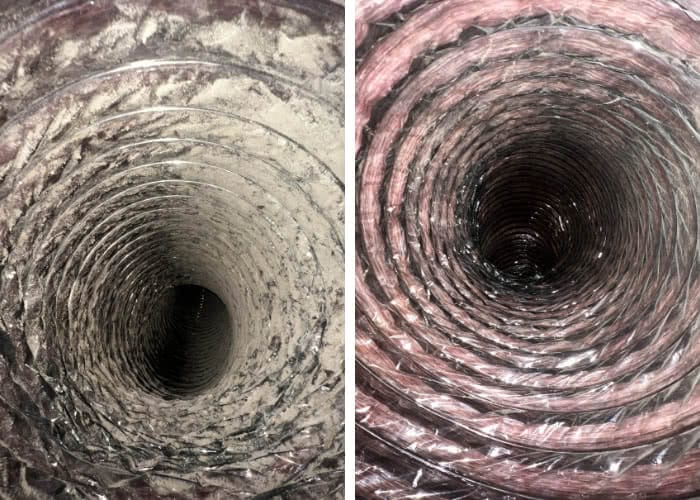
A duct inspection, step by step — what "we will look first" means
Room-by-room airflow read
We start inside the house, at the vents, with the system running. Which rooms blow strong, which barely move air, which doors pull shut — that map points at the runs to check.
Static pressure measured
A gauge reading that shows how hard the blower pushes against your ducts and filter. High pressure with weak rooms means the air is choked or leaking, not that the unit is small.
Under or over the house, with a camera
Crawl space or attic, run by run: connections, sags, kinks, torn liner, insulation state. You get the photos, good or bad.
Findings sorted by the four jobs
Cleaning, sealing, repair, or added returns — each finding lands in the job that actually fixes it, priced as its own line.
You pick the work, in order
Repair before sealing, sealing before cleaning. If only one run is bad, the quote says one run.
Repair the run or replace the run?
| What we find | Usual call | Why |
|---|---|---|
| One connection pulled off a boot or collar | Repair and seal | The run itself is sound; the joint failed |
| Flex duct sagging in bellies between straps | Re-hang and straighten, replace if the liner is torn | Air slows in every belly; a torn liner cannot be un-torn |
| Inner liner shredded or jacket soaked through a summer of sweating | Replace that run | The insulation value and the air path are both gone |
| Whole system is 1970s–80s flex, brittle at every touch | Plan a phased replacement, worst runs first | Patching brittle duct buys months, not years — we will show you the photos and phase it honestly |
| Runs fine, room still starved | Added return or resized run | That is a design fix, not a condition fix — see the redesign row in the table above |
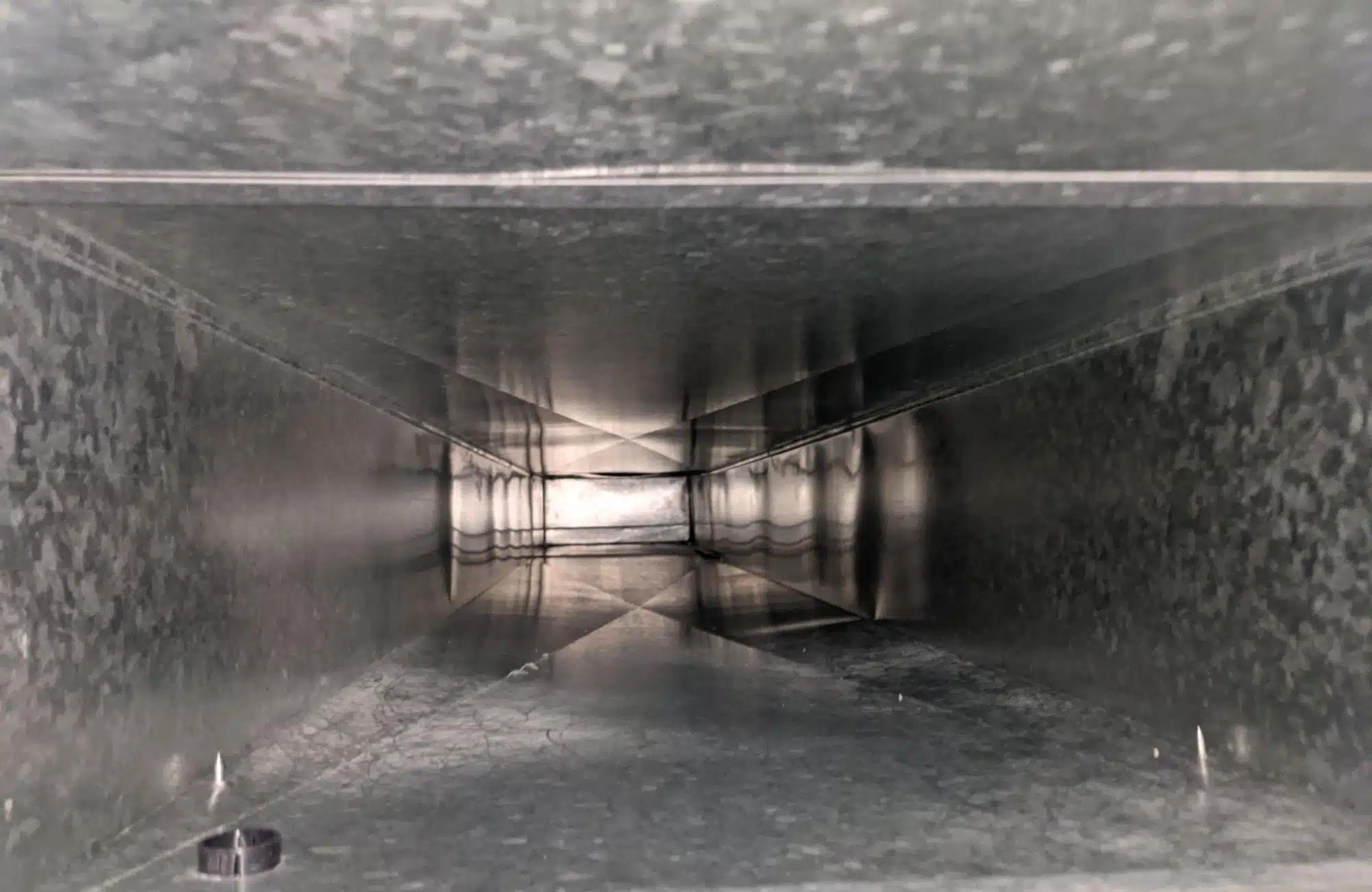
What Columbia ducts are made of — and how each kind fails
| Material | Where we find it | How it fails here |
|---|---|---|
| Flex duct | Most branch runs in homes from the 1970s on — ranches off Hampshire Pike, attic runs in newer builds | Sags in bellies between straps, kinks at tight turns, inner liner tears with age, jackets soak through when insulation fails in a damp crawl space |
| Galvanized sheet-metal trunk | The main line in older and downtown homes, often the backbone flex branches hang off | Joints and seams leak where tape dried out decades ago; the metal itself lasts — the connections are the problem |
| Duct board | Formed trunks and plenums in some 1980s–90s builds | Inner surface roughens and holds dust, edges crush at connections, and water damage softens it — a run that has been wet is a replacement, not a cleaning |
How duct cleaning actually works — the first-timer version
If you have never had ducts cleaned, the honest version is short. The system is put under negative pressure — a powerful vacuum holds the ductwork under suction — while compressed air tools work inside each run to loosen dust and debris, which the suction carries out instead of blowing it into your rooms. Registers and the trunk lines are worked run by run, and the job ends the way our inspections start: photos of your own ducts after, so “clean” is something you can see. An estimate for cleaning should say, in writing, which runs are included, whether the trunk and returns are in or out, and what happens if the inspection finds crushed or disconnected duct that cleaning cannot fix — because that finding changes the job from cleaning to repair, at a separate price you approve first.
Uneven air is a diagnosis first, not a cleaning by default
One room hot, the first floor cold, air barely spreading to the far rooms — those complaints arrive at this page labelled “duct cleaning,” and cleaning is often not the fix. Uneven air is measured first: static pressure, vent-by-vent airflow, return size, and the state of the runs. A starved room is usually a leak, a crush, a missing return, or a layout problem — and when two floors honestly live at different temperatures after the ducts are fixed, that is a zoning conversation. Cleaning a duct that leaks gives the leak a cleaner pipe; measuring first gives you the right job.
Sealing: how it is done, and how you know it worked
Most Columbia sealing is hand work: mastic — a thick, paint-on sealant — worked into the joints, boots, and connections a tech can reach from the crawl space or attic, with failed tape removed rather than covered. There is also an aerosol method that seals a system from the inside under pressure; it is a specialty service sold under brand names, and if a house needs it we will say so and name it as work to price separately, not pretend our mastic is the same thing. Either way, sealing has to end in proof, and the proof is measurement: static pressure and vent-by-vent airflow read before the work and read again after, with both sets of numbers on your invoice, plus photos of the joints that were sealed. A sealing quote with no before-and-after numbers is asking to be taken on faith.
Returns and filter size — the quiet half of airflow
Supply ducts get the attention; returns do the limiting. A blower can only send out the air it can pull in, and many Columbia houses were built with one small return for the whole system. Starve the return and static pressure climbs, the blower works harder, rooms at the end of the run go weak, and the filter — if it is a thin 1-inch slot doing the whole house's filtering — loads up and chokes the system faster between changes. On a duct inspection we measure total static pressure with the filter in place, check the return size against the airflow the system needs, and tell you plainly if the fix is a bigger filter rack, an added return, or nothing at all. A duct sized for one airflow cannot quietly carry a lot more: push it and you get noise, pressure, and leaks at the seams, not more comfort. That is also why zoning a house starts with this measure — the numbers are on our thermostats & zoning page, and a system kept on schedule is on the maintenance page.
Proof on duct work, not promises
- Licensed & insured in Tennessee, working from 1230 Industrial Park Rd, Columbia
- Photos of your own ducts — the runs, the failures, and the finished work — because “bad under there” is not a finding
- Before-and-after measurements on sealing and repair jobs: static pressure and airflow at the vents that were failing, both readings in writing
- Each job priced as its own line — cleaning, sealing, repair, added returns — so you never pay for the one your house does not need
Not sure if your house needs cleaning, sealing, or repair?
Call for a duct inspection. We look first, show you photos of what we find, and price only the job your ducts actually need — in writing, before any work starts.
Licensed & insured in Tennessee · ★★★★★ 5-star rated · 25 years in business · 1230 Industrial Park Rd, Columbia, TN
Duct FAQs
Is duct cleaning worth it?
Sometimes. It helps after remodel dust, a rodent problem, visible debris, or years of buildup with a musty smell at start-up. It does not fix weak airflow, hot rooms, or high bills — those are leaks, crushes, and sizing. Any company that sells cleaning as the cure for all of it is selling, not diagnosing.
How often should air ducts be cleaned?
Honest answer: the sources do not agree, and we will not pretend they do. The EPA does not put duct cleaning on a routine schedule — it points to cleaning when there is a clear reason, like visible mold, pest debris, heavy dust and debris, or dust left from a remodel. The duct-cleaning trade group talks about every 3 to 5 years. We work from the EPA side of that split: we look first, show you photos of your own ducts, and clean only when we find a reason. A low-price whole-house cleaning ad is usually priced to get a tech in the door, not to clean your ducts.
Why does dust come back a day after I clean the house — and why does my bedroom door pull shut when the AC runs?
Both point at the same thing: air going where it should not. Dust that returns overnight usually means leaky returns pulling attic or crawl space air — and everything in it — into the system, past the filter. A door that swings or pulls shut when the blower starts means that room has supply air going in and no good path back out: no return, or a return that is blocked or too small. Neither one is fixed by cleaning. Both are fixed by finding the leak or the missing return path and sealing or adding it.
What is the difference between duct cleaning and duct sealing?
Cleaning takes material out of the ducts. Sealing keeps conditioned air in them. A spotless duct that leaks a third of its air into the attic still wastes money every hour the system runs. For most pre-1990 Columbia homes, sealing and repair pay back; cleaning is the add-on.
Can duct work fix my hot upstairs?
Often, yes — undersized or leaking upstairs runs and missing returns are the usual cause. Sometimes it takes zoning as well. We measure first and tell you which fix matches the cause.
The room with no vent at all — adding a run is a duct job
A different call comes in now and then: the AC runs through the rest of the house, but one room — a finished attic, a converted garage, a downstairs room the remodel enclosed — has no vent in it at all. That room does not need cleaning, sealing, or a bigger unit. It needs a run: a new supply branch and register, sized off the trunk, plus a way for air to get back out of the room, because a room with supply and no return path just pressurises and stays uncomfortable. Adding a run is design work, done the Manual D way — the trunk has to have the air to spare, the new branch is sized rather than guessed, and static pressure is read after, so the new vent does not steal the far bedroom's air to feed itself. Where the trunk honestly cannot spare the air, or the room sits too far from it, the honest alternatives are the ones on the thermostats & zoning page and the mini-splits page — and we will say which one your house is before anyone prices ductwork. Call and describe the room; “the AC runs through the house but this room has no vent” is the whole symptom, and it is enough.
Related work on this site
Duct findings usually pull in two neighbours: the moisture side lives on our indoor air quality & dehumidifiers page, the under-house runs live on the crawl space & attic HVAC page, and every town we run duct work in is listed on the areas we serve page. One pipe this page does not cover: the dryer vent is the dryer's own exhaust, a separate system with its own cleaning — it has its own page, dryer vent cleaning. Short answers first? The HVAC FAQs sort cleaning vs sealing in two paragraphs.
Hot rooms and high bills usually live in the ducts.
Call for the inspection and see the photos before you spend on either cleaning or sealing. The price for the job your house needs goes in writing first.
Licensed & insured in Tennessee · ★★★★★ 5-star rated · 25 years in business · 1230 Industrial Park Rd, Columbia, TN